
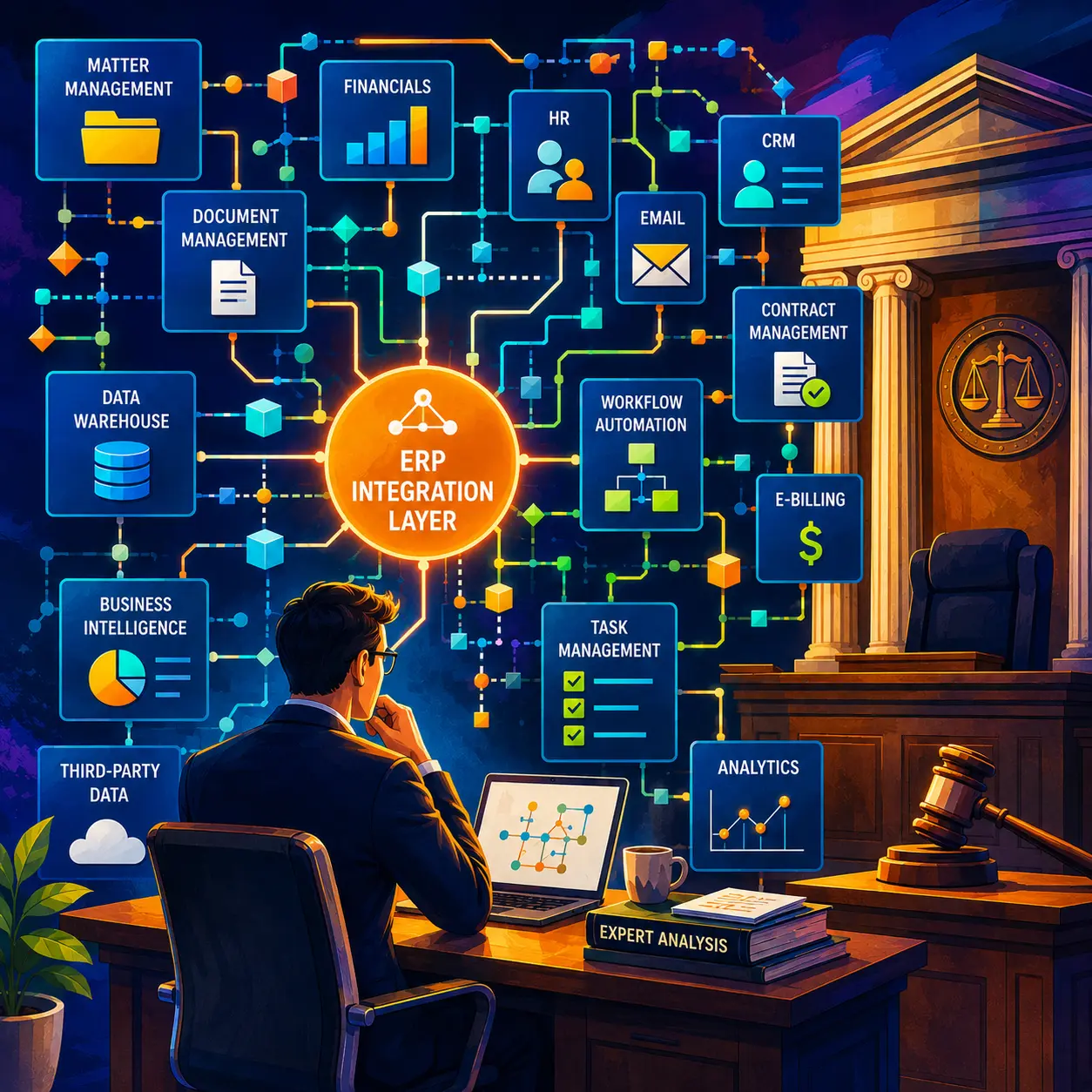
ERP Expert Witness: How to Choose One for Enterprise Systems Implementation Failure Dispute Litigation

    DisputeSoft
    ERP Expert Witnesses


    Enterprise Resource Planning or “ERP” software generally consists of a suite of integrated software applications that can be used to collect, store, manage, interpret, and transform data from a range of business activities. 

    These software systems can, and often do, simultaneously touch upon many of a business’s critical operations, such as HR, finance, supply chain, manufacturing, and sales providing key insights into many aspects of business operation and ensuring those processes are carried out in an integrated manner.

    By their design and nature, such systems are very large and incredibly complex due to their integration of real-world business data, IT systems, and processes. 

    ERP solutions offered by some of the largest technology companies in the world represent perhaps some of the most complex and costly software implementations a business will ever undertake. While incredibly valuable and helpful, these systems are imperfect, and errors and failures do happen.

    When they fail, the financial implications can be severe. Not only are these systems expensive to implement, but because of their technical complexity, the fallout from their failure can substantially impair a business’s operation, increasing the  likelihood of litigation.

    Due to their technical complexity and the many components of a customer’s business they impact, disputes over failed ERP implementations present unique evidentiary challenges. 

    Understanding the full technological scope of such a system is often critical to facilitating thorough analysis. Further, the technical analysis required to understand the failure points are far more nuanced than other types of software failure cases due to the complexity of these systems. 

    That’s precisely the role of an ERP expert witness: to perform in-depth technical analysis to investigate these complex systems and evaluate the root causes of failure.

    Thus, choosing the right ERP expert witness can be one of the most consequential decisions attorneys can make in these types of matters. In this article, we highlight what makes ERP disputes stand out from other forms of software litigation, as well as outline some non-exhaustive factors to consider when searching for the right ERP expert witness.

    What Makes ERP Disputes Different from Other Software Litigation

    What makes ERP disputes different from other types of software litigation is the technological scope of material relevant to the dispute. In our experience, issues that are litigated, rarely if ever, are isolated to just a single isolated technical failure that’s readily identifiable. 

    Instead, issues experienced in ERP implementation tend to compound one another at various phases of an ERP implementation project or influence other technical touchpoints throughout the project.

    For example, requirements misalignment can result in downstream change orders that require significant rework; data migration failures can result in integration breakdowns and drive a project toward failure in testing phases; and project management issues can result in project schedule delay, labor imbalances and cost increases. 

    All of these have the potential to impact go-live decision making.

    Because of these potential impacts, numerous systems of record and categories of documentation are critical for an ERP expert witness’s technical analysis. For example, the development and implementation systems used to build the integrated product can be essential to understanding a vendor’s efforts to build the system, and often include vital information, such as requirements traceability data, testing data, defect logs, and more.

    Further, large volumes of documentation are typically as critical to the analysis as the systems themselves to be able to probe communications and observations, and corroborate what happened contemporaneously with the data produced by the systems of record. 

    For example, contract documents, SOWs, change orders, project plans, defect logs, project schedules, emails, user acceptance testing records, and other general project communications all can help tell the story of what was happening and key points in time along the project timeline. Consequently, an ERP expert witness’s qualifications and capability to assume often voluminous work involved in supporting the dispute are paramount.


     

    Core Qualifications to Look for in an ERP Expert Witness

    The right ERP Expert witnesses can be vital to the success of the matter, and in our experience, we’ve found that the most successful litigants tend to consider some very important factors when looking for an ERP expert witness to support their case. Below is a brief, non-exhaustive list of some of the factors our clients have considered when evaluating for fit:

    a)        ERP Implementation Experience

    Litigants often look for someone who has designed, configured, tested, or managed enterprise system implementations in a real-world environment. Typically, someone who has only studied ERP systems academically, or who has minimal experience in the field, is untenable. Those with demonstrated experience understand how the various modules interact, how data flows across the systems, and where implementations typically suffer from breakdowns.

    Experts lacking direct ERP experience, and who rely solely on academic credentials or other less complex software dispute experience may be at a disadvantage just in terms of the relative volume and complexity of the work involved. Such experts may struggle to thoroughly understand the system with the level of detail necessary to fully elucidate the issues in a meaningful way.

    b)   Familiarity with Major ERP Platforms

    Litigants also look for someone who has substantive familiarity with the platform at issue, such as SAP, Oracle E-Business Suite, Oracle Cloud, Microsoft Dynamics 365, NetSuite, or others. An ERP expert witness who has previously worked with certain of these complex systems will be able to approach their analysis using prior experience as an initial starting point: anticipating where the disputes are common or likely, and knowing which information is needed to investigate. Thus, litigants often ask about the expert’s experience with the system or even the industry involved in the dispute.

    Experts unfamiliar with the specific platform or even the industry vertical at issue, or both, may be significantly disadvantaged. Not only will the expert be responsible for learning “on-the-fly” an inherently complex system, but they will not have the available time and/or resources to match the impact of a more directly experienced ERP expert witness will have already expended in acquiring their expertise.

    c)        Knowledge of Industry-Standard Implementation Methodologies

    An ERP expert’s knowledge of industry-standard implementation methodologies and standard industry practices is significant in these types of matters. ERP projects routinely follow recognized methodologies or paradigms. Effective ERP expert witnesses should be able to evaluate whether a vendor or customer adhered to accepted industry practices or industry standards and demonstrate where deviations from those standards and practices contributed to failure. 

    d)   Experience with Data Migration and Integration Issues

    With many ERP failures rooted in data migration problems, integration failures with legacy systems, or poor data governance, an ERP expert witness who understands data integration and management has an advantage. 

    There is credibility that comes from demonstrating actual experience with debugging data pipelines, or speaking to certain tools and methodologies often deployed in these processes, and their efficacy and reliability. 

    ERP expert witnesses tend to have concrete examples of this type of work; and effective experts will be able to rely on this experience to evaluate data and integration issues thoroughly to be able to demonstrate the extent to which the failure is caused by them.

    Experts without the direct hands-on experience of dealing with real-world messiness like dirty data or data field mapping conflicts, or unable to translate the impact of these data issues in terms of business impact will be vulnerable on cross-examination.

    e)        Balanced Experience on both Sides (e.g., not customer-only, or vendor-only)

    While ERP experts play an important role in software dispute litigation, the depiction of an expert as a “gun for hire” or “mercenary” is a common disparaging line of attack that opposing counsel may seek to exploit at every opportunity. To inoculate against it, litigants are encouraged to seek ERP experts with careers that reflect substantive experience on both the vendor and customer sides of both ERP implementations and ERP software disputes. 

    Experts who have advised software publishers on implementation methodology and have represented the interests of end-user organizations navigating failed deployments present a balanced professional history which signals independence and objectivity. This lends credibility to their analysis and makes it harder for opposing counsel to paint them as an advocate.

    An ERP expert with significant one-sided experience invites scrutiny on cross-examination strictly on that point, before the substance even comes into question.

    f)          Ability to Explain Highly Technical Concepts to Non-Technical Audiences

    An ERP expert’s ability to explain these technically complex systems and the issues that arise in simple terms can influence the outcome greatly. Moreover, experts who are unable to clearly explain technical concepts or illustrate how the data and their technical analysis supports their opinions may face great difficulty under scrutiny. Simply put, an expert who cannot explain the systems or the issues within to an attorney familiar with the case in a way that makes sense is likely going to be unable to do so for a judge or jury in a meaningful way. 

    Often, experts in these types of cases are highly skilled at simplifying the information and data they’ve assessed in a way that is approachable and meaningful.

    Experts that try to stretch data to establish certain conclusions can be readily figured out by well-prepared attorneys on cross-examination or opposing experts who have considered the same data but reached different conclusions.

    g)        Team-based approach

    ERP expert witnesses that operate in a team environment can leverage significant advantages over individual expert witnesses lacking robust analyst support. 

    As discussed above, supporting these matters through the entire litigation lifecycle can be an incredible undertaking due to the complexity and volume of information involved. Expert witnesses that operate by directing highly skilled supporting staff can simplify the workflow by delegating more time-consuming tasks, and introduce increased intellectual rigor and peer review of the methodologies, analysis, findings, conclusions, and opinions. 

    A team-based approach to supporting ERP software disputes allows the work to proceed at a better pace with more quality insights.

    What an ERP Expert Witness Actually Does in Litigation

    An ERP expert witness can assume many roles across the litigation lifecycle, and it’s often to one’s advantage to retain such an expert as early in the litigation process as is feasible, as doing so can help litigants understand the facts, and their associated complexity, early enough to help build a case strategy. Below are some examples of how ERP experts can support attorneys in the various phases of these proceedings:

    a)        Pre-litigation Assessments

    ERP experts can help review contract documentation, SOW’s, and other technical project documentation to provide a preliminary evaluation or pre-litigation assessment of the strength of the failure claims before a complaint is ever filed. In reviewing this documentation, an ERP expert can gain a broad-view understanding of the scope of the project, identify the major points in the timeline that will likely be key to an investigation, and begin developing hypotheses about potential root cause(s) of failure. 

    b)   Discovery Support

    ERP experts can help attorneys identify key systems of record and technical documentation to request, which data to preserve, and which system artifacts are going to be highly material to the dispute (e.g., defect logs, project dashboards, change orders, requirements documentation). Moreover, an ERP software expert witness with supporting staff can even assist in preservation of material artifacts, if necessary.

    c)        Root Cause Analysis

    One of the core components of an ERP expert witness’s work is to determine whether the resulting software failures stemmed from an identifiable root cause, such as vendor or client misrepresentation, poor requirements gathering or elaboration, defective or deficient code or configurations, flawed project management, unrealistic client expectations, inadequate or deficient testing practices, some combination of any or all of the above, or even some other explanation. In this regard, an ERP expert witness’s holistic understanding of the project and its technical complexity can heavily influence the outcome of the case simply through skillful articulation of the issues and their impact. 

    d)   Percent Complete and Damages Support

    An ERP expert witness can assess how far along in the implementation project the parties were at the time the dispute arose and provide reasonable estimations as to when the project could have been completed but for the rising dispute. This can be an important technical input to support calculation of damages or facilitating a settlement. 

    e)        Expert Report and Testimony

    Paramount to these types of cases is the ERP expert’s ability to prepare a carefully drafted, technically detailed written report and supporting documentation. The level of complexity necessitates both high-quality analysis and high-quality report construction that clearly illustrates the materiality of the expert’s findings and opinions and offers that material to the judge and/or jury in an understandable way. Moreover, supporting an expert’s report with clear and thorough deposition or trial testimony helps drive the narrative that the facts support.

    How ERP Expert Analysis Supports Both Customers and Vendors 

    Highly credible ERP expert witnesses approach each matter objectively, allowing the evidence to point them toward their conclusions, rather than advocating or searching for an explanation for a predetermined conclusion. This objective and evidence-driven method bolsters an expert’s testimony, making it stronger and less susceptible during cross-examination or other challenges.

    For example, on the customer side, an ERP expert witness can help establish that a vendor failed to deliver a functioning system, misrepresented functional capabilities of the system, or even deviated from accepted industry standards or practices in carrying out the implementation. On the vendor side, an ERP expert witness can help demonstrate that a client’s own conduct materially contributed to the outcome: examples such as scope creep, failing to provide timely decisions, inadequate change management, or unrealistic timeline expectations. Consequently, ERP expert witnesses who approach these disputes objectively can support either customers or vendors in these matters by maintaining objectivity and letting the facts drive the investigation.

    Conclusion

    ERP implementation disputes are among some of the most technically complex commercial litigation matters involving software. The right ERP expert witness brings direct platform experience, methodological rigor, and the communication skills to make complex details, findings, and opinions accessible to a court. 

    Engaging that expert early in the process can meaningfully shape the case strategy, and potentially the outcome, from pre-litigation phases through trial and judgment. Contact the ERP expert witnesses at DisputeSoft for further information.


    Frequently Asked Questions about ERP Expert Witnesses

           1. What is ERP Software?

    Enterprise Resource Planning or “ERP” software generally consists of a suite of integrated software applications that can be used to collect, store, manage, interpret, and transform data from a range of business activities. These software systems can, and often do, simultaneously touch upon many of a business’s critical operations, such as HR, finance, supply chain, manufacturing, and sales.

    2.        What is an ERP expert witness?

    An ERP software expert witness is retained to undertake a thorough investigation of an ERP software system and its related project artifacts to reach findings of fact, draw conclusions, and form opinions as to what the root cause of a project’s failure likely is.

    3.        What are some key factors attorneys should consider when seeking the assistance of an ERP Software Expert Witness?

    ·      Which ERP systems the expert has worked with directly, and in what capacity.

    ·      Which industries has the expert worked in, and whether they’ve analyzed systems in the industry relevant to the immediate dispute.

    ·      Whether the expert has testified on ERP-related matters before, and in which courts.

    ·      Whether they have experience in developing and defending analyses and opinions relating to ERP systems in software disputes.

    4.        How can an ERP expert witness help parties in active litigation concerning an ERP project failure?

    ·      Pre-litigation Assessments to evaluate the strength of a case on a limited set of information.

    ·      Discovery support to help identify, preserve, analyze, and understand the large volume of data and information relevant to the dispute.

    ·      Root cause analysis to identify the cause(s) of the project’s failure and contributing factors.

    ·      Percent complete analysis to determine the degree to which the project was finished at the time the dispute arose.

    ·      Expert testimony in the form of written reports, deposition testimony, and trial testimony to explain in detail the nature of the dispute.

    5.        How are ERP software implementation projects different from other software implementation projects?

    ·      Complexity: ERP software systems are comparatively more complex and tend to support more mission-critical or sensitive components of an organization’s business operation.

    ·      Structured: ERP systems are built around industry best practices and industry standards and implemented using standard industry practices and methods.

    ·      Expensive: ERP implementation projects are typically long-term ventures involving large financial and operative commitments.

    ·      Increased Risk: Due to the above factors, combined with numerous others, the risk financial exposure if the ERP system fails is higher.