
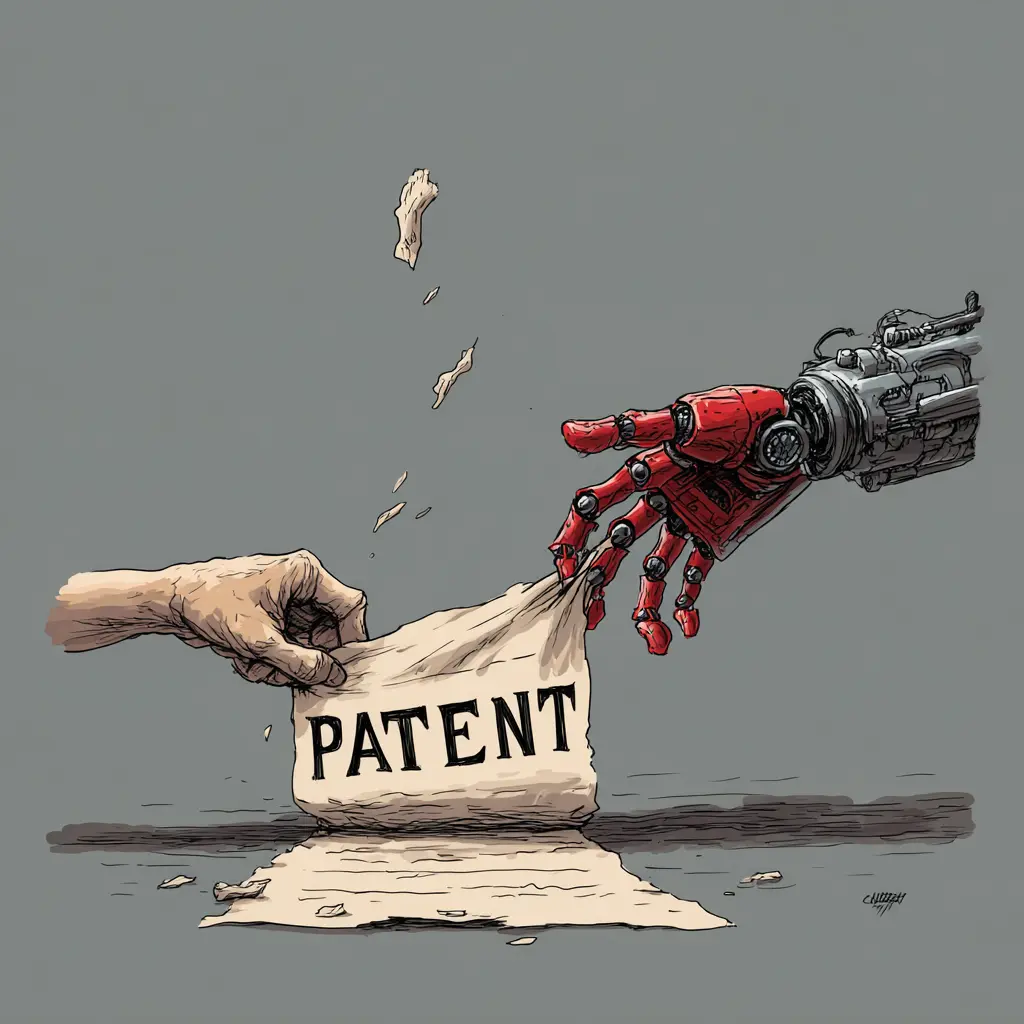
In November, 2025, the United States Patent and Trademark Office (“USPTO”) issued new guidance on the usage of AI in developing patents. 1
The new guidance provides clarification and detailed specifics on what is, and what is not, acceptable use of AI tools in seeking patent protection for inventions.
Here are three takeaways from the updated guidance.
1 – The USPTO will view AI use as merely a tool
There is no barrier preventing use of AI as a tool to aid inventors in developing patentable subject matter; instead, AI will be considered as just another tool a potential inventor may use to create new inventions.
This explicit clarification states that it is perfectly acceptable to use AI as a tool to aid in creating new inventions for potential patents, with the same considerations as, for example, using computer-assisted-design software, blueprints, or physical tools.
2 – Inventors must be human
The USPTO states that only “natural persons,” i.e., humans, can qualify as “inventors” for the purposes of patent protection. The key concept here for patents is “conception,” which requires sufficient knowledge and detail held in the conceiver’s mind to put the invention into practice. 2
In fact, the USPTO goes further to state that, “any application that lists an AI system or other non-natural person as an inventor or joint author” will be rejected. 3 This guidance is analogous to guidance from the U.S. Copyright Office, where authors of copyrights must be humans.
3 – Documenting work created by humans is important
Documentation that reflects and demonstrates the human versus non-human contributions will likely become key to acquiring and protecting patent rights, similar to what is anticipated in the copyright landscape.
For example, the Copyright Office has already issued guidance taking a firm stance that creative works authored by humans are eligible for protection while portions generated by AI would not qualify. There is already a growing interest in the technology industry focused on developing tools to distinguish and track human versus non-human contributions, as well as authenticity, pertaining to creative works. 4
One potential use case for these types of tools is to be able to assist authors and creators in appropriately identifying which portions of a creative work are human-authored versus those that are AI-generated, to assist in determining the scope of one’s copyrights, should they ever come into dispute.
The consideration of whether, and/or to what extent, the underlying work is probably human authored becomes one of the key elements that already serve to restrict the copyright scope. Thus, for the purposes of copyright-based disputes at least, tracking which portions are the result of human authorship versus AI generation will likely have a material impact on the outcome of such a dispute.
From this guidance, it appears the USPTO is at least suggesting a similar approach for patentable subject matter. Since non-human AI is merely a tool from the perspective of the USPTO, AI cannot be an inventor. Consequently, tracking and documenting the human contribution to the conception of the patent, against how the AI tools aided in its reduction to practice, is likely to have a similar material impact on both acquiring and defending a given patent.
Under this new guidance, it will be important to be able to demonstrate that the humans involved “conceived the invention under the traditional conception standard” per the new guidance, and clear tracking and documentation of the human conception will be vital to that inquiry. 5
***
When it comes to complex litigation, technology due diligence, and AI in the context of Intellectual Property, DisputeSoft’s experts have deep expertise in software patent disputes to help you and your software patent litigation team make sense of fast-evolving technology.
DisputeSoft experts understand the various issues at the intersection of AI, patents, copyrights, and source code.
- See https://www.reuters.com/legal/government/us-patent-office-issues-new-guidelines-ai-assisted-inventions-2025-11-26/ and https://www.govinfo.gov/content/pkg/FR-2025-11-28/pdf/2025-21457.pdf. ↩︎
- See https://www.govinfo.gov/content/pkg/FR-2025-11-28/pdf/2025-21457.pdf, p. 2.
↩︎ - Id.
↩︎ - See e.g., https://builtin.com/artificial-intelligence/ai-detection-tool; see also https://opensource.contentauthenticity.org ↩︎
- See https://www.govinfo.gov/content/pkg/FR-2025-11-28/pdf/2025-21457.pdf, p. 2. ↩︎